Guide
Kitchen Quick-Fixes Checklist: Drying, Opening, Sharpening and Brewing
Small kitchen jobs, one checklist. It shows what to measure and which specifications matter for dish racks, jar openers, knife sharpeners, tea infusers and coffee scales.
Most kitchens don’t need new appliances. They need a few small tools that remove daily friction: a counter that doesn’t flood, a lid that opens, a knife that cuts cleanly and a cup of tea or coffee that comes out the same way twice. This checklist takes those jobs one at a time. For each it says what to measure, which specifications are worth reading and where our comparisons can narrow the field.
1. Dishes: measure the counter before you count the plates
A rack that is too big takes over the counter, and one that is too small leaves wet dishes on a towel. Start with the free space, then think about how many dishes you wash on a typical day.
- Measure depth and width. In our dish drying rack comparison, the full-size rack measures about 15 × 20 in (depth × width) and the compact one-tier racks about 11 × 15 in. One entry is a sink-corner caddy for sponges and brushes, not a plate rack, so read the type carefully.
- Check for an adjustable width. Only two of the eight list one, from 12.2 to 21.7 in and from 15.2 to 22.1 in. That helps in a small kitchen where the rack shares the counter with a coffee maker.
- Compare the stated capacity. The clearest listing names 10 plates, 12 bowls and 6 glasses, while a compact rack names six plates plus bowls and glasses.
- Look at drainage. Most racks list an angled tray or drainboard, and four add a spout or swivel spout. Without a way for the water to reach the sink, it ends up on the counter.
- Read the weight limit. Five listings give one, from 3 lb to 50 lb. Heavy pots need a rack whose limit is above their weight.
2. Stuck lids: choose by lid size and hand strength
A jar opener only helps if it fits the lids you actually struggle with, so collect a few stubborn ones and measure across the top before you compare. The jar opener comparison covers very different tools: a lever opener, two toothed grip openers with a base pad, a battery-operated electric unit, a multi-hook handle, a three-piece set, an adjustable steel opener and a six-pack of seal-release hooks.
- Match the lid range. The widest stated range is 0.2 to 5.3 in. The electric opener lists 1.2 to 3.5 in, the adjustable steel tool about 1 to 5 in, and two grip openers say “any size” without giving a range. One set states no range at all, so you can’t check that fit in advance.
- Decide how much effort you can spare. A motor removes the twisting but needs batteries and fits only its stated range. Seal-release hooks only break the vacuum; you still twist the lid off by hand afterwards.
- Check bottle caps. Six of the eight list bottle caps as well, which can save you a second gadget in the drawer.
- Read the warnings. One listing says its adjustable opener can slip if it is not seated firmly. A base pad that holds the jar still, as on the two grip openers, takes some of the work off your other hand.
- Look at cleaning. One opener is listed as dishwasher safe on the top rack; on another, the opener goes in the dishwasher but the pad is hand wash only.
3. Knives: choose how much control you want
Sharpeners differ less in grit than in how they guide the blade. The knife sharpener comparison separates four pull-through models, two rolling kits, one electric unit and one guided bench system.
- Angle control. Only the bench system lists an adjustable guide, from 15° to 30°. The electric unit sets a 15° edge with spring guides, one rolling kit offers 15° or 20°, and none of the four pull-through models states an angle. If you own knives with different edges, that difference matters.
- Serrated blades and scissors. Three listings name support for serrated knives and one says its sharpener is not suitable for them. Two pull-through models add a scissor slot.
- Abrasive stages. Pull-through slots are labeled coarse, medium and fine, or repair, sharpen and polish. The bench, electric and rolling units list diamond abrasives, and several add a ceramic stage or a strop for finishing, while one handheld unit has a single coarse stage and no fine step.
- Size and storage. Listed weights run from 1.6 oz for the handheld unit to 4.2 lb for the electric one. A heavier unit stays put on the counter but needs a home in a cabinet, and several pull-through models list a non-slip base to keep them steady.
Whichever type you choose, follow the maker’s instructions for the knives it supports, and keep your fingers clear of the slot or disc.
4. Hot drinks: steeping and weighing
Tea: pick the infuser by leaf size
Leaves need room to open, and the mesh has to be fine enough to hold them back. The loose leaf tea infuser comparison includes two lidded baskets, a ball with a screw-on lid, hanging balls on chains or hooks and a snap-shut ball on a long handle. Baskets give the leaves more space than small balls do. Five of the eight listings are described as suitable for fine or small leaves, while two warn against small or ground tea, so skip those for rooibos or broken-leaf blends. Four come with a lid, saucer or drip tray, which saves a mess when you lift the infuser out. Cleaning advice ranges from dishwasher safe to rinse-and-dry only.
Coffee: weigh and time every brew
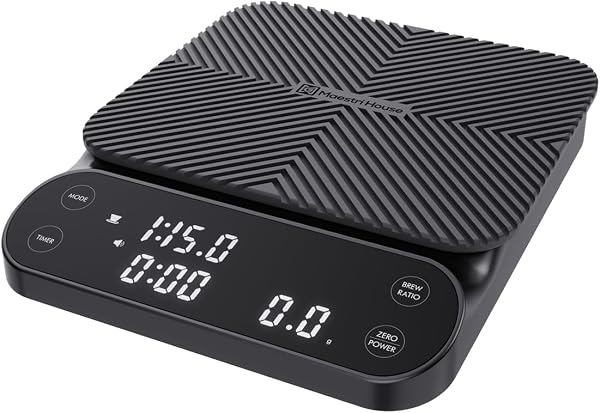
A coffee scale pays off only if you repeat your recipes. In the coffee scale comparison, all eight models read to 0.1 g, so the differences lie elsewhere:
- Capacity. Two stop at 2,000 g (about 4.4 lb) and six reach about 3,000 g (6.6 lb). Weigh your server or cup plus the brew before you rely on the smaller range.
- Timer behavior. Listings describe manual timers, automatic timers that start with the first pour and count-up or count-down modes. Flow-rate or flow-speed tools appear on three models only.
- Power. Five are rechargeable, mostly over USB-C, and three use batteries.
- Warranty. Only one of the eight lists a warranty, five years.
For the rest of the counter routine, see our grind, weigh, froth and blend checklist.
5. Before you buy: a short measuring routine
- Free counter depth and width where the rack will stand, plus the clearance under any wall cabinet
- The diameter of your largest and smallest jar lids
- The length of the longest knife you want to sharpen, and whether any of your knives are serrated
- The size of your cup, mug or pot, to decide between a basket and a ball infuser and to check the scale’s platform
Quick checklist
- Rack footprint fits the counter, and the type is a plate rack, not a utensil caddy
- Rack capacity and weight limit cover a normal day of dishes and your heaviest pot
- Opener’s stated lid range covers your smallest and largest lids
- Opening method matches your grip: lever, grip pad, motor or seal release
- Sharpener’s angle control and serrated-blade support match your knives
- Infuser type and mesh match the tea you drink most often
- Scale capacity covers your server, and the timer and power source suit your routine
The comparisons linked above rest on manufacturer data, and nobody on our team has handled the products. Each page lists its criteria and weights, and our editorial method explains how scores and awards are calculated. You can browse every kitchen comparison in our kitchen category.
Related comparisons


More guides
Coffee and Breakfast Counter Checklist: Grind, Weigh, Froth, Blend
A good morning counter needs only a few tools. This checklist covers grinding, weighing, frothing and blending, and shows which specifications to check before you buy.
How to Make a Latte at Home Without an Espresso Machine
Brew the coffee in a moka pot on the stove, then add milk heated and frothed in an electric frother jug or whisked with a handheld …