Guide
Coffee and Breakfast Counter Checklist: Grind, Weigh, Froth, Blend
A good morning counter needs only a few tools. This checklist covers grinding, weighing, frothing and blending, and shows which specifications to check before you buy.
A morning counter does not need a machine for every job. Four small tools do most of the work: something to grind beans, something to weigh them, something to froth milk and something to blend. This checklist goes through them in the order you use them. For each step it says what to measure, which specifications matter and where our comparisons can help you narrow the field.
1. Grind fresh beans
A hand grinder is quiet, needs no outlet and fits in a drawer or a bag. What separates one from another is how finely you can set it and how it is built.
- Look for the click size. In our manual coffee grinder comparison, only the KINGrinder (16 microns per click) and the Vaneo (17 microns) state it. Smaller steps matter most for espresso. For French press or cold brew, a coarse range with fewer steps is enough.
- Check the capacity. Five listings state 25 to 30 grams, which is roughly one or two cups. Plan on several fills if you brew for a group.
- Weigh the grinder as well. Listed weights run from about 6.3 ounces to 1.9 pounds, so a travel grinder and a counter grinder are different choices.
- Check the warranty. Only three of the eight state one, from six months to a year.
2. Weigh beans, water and ingredients
Weight is more repeatable than scoops, whether you brew coffee or bake. Two kinds of scale cover the job.
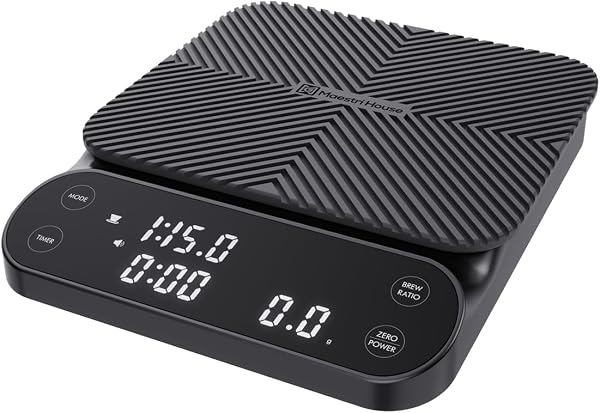
- A coffee scale for brewing. Our coffee scale comparison covers scales that read to 0.1 g and include a timer, which suits pour-over and espresso.
- A kitchen scale for everything else. In our kitchen scale comparison, six of the eight stop at 11 pounds, one reaches 22 pounds and one 33 pounds. Most read in 1-gram steps, and a 0.1-ounce step is about 2.8 grams, so grams give the finer reading.
- Check the platform. Only two listings state a platform size, 9 × 6.3 inches and 7.5 × 5.5 inches, so look at the pictures if you weigh into large bowls.
- Look at the power. Most use AAA batteries, one charges over USB-C and one uses a button cell.
3. Froth the milk
Milk drinks are where counter tools differ most. A wand froths milk that you have already warmed, while an electric jug heats and froths in one step.
- Choose wand or jug first. Our milk frother comparison covers three handheld models and five electric jugs, and only the jugs list heating.
- Check the foam volume. Stated frothing volumes run from 3.9 to 6.1 fluid ounces (115 to 180 ml), which is one or two cups.
- Read the care line. Five of the eight are hand wash only, and a powered base never goes in water.
- Match the milk. One listing advises milk with more than 3 percent fat for better foam, and plant-based milks behave differently.
For the whole recipe, see our answer on making a latte at home without an espresso machine.
4. Blend soups and smoothies
An immersion blender goes into the pot or jug, which saves washing a standing blender.
- Compare power with speed control. In our immersion blender comparison, listed wattage runs from 180 W to 1,100 W, but wattage is the maker’s figure and says little about blade design.
- Count the attachments you will use. Five sets include a whisk and four a chopper. A beaker helps with small batches.
- Protect your cookware. Look for a pan guard, a nylon blade guard or splash control, and check the manual before blending in a non-stick pan.
- Check the cord and weight. Listings state weights from 1.4 to 5 pounds, and only two give a cord length.
5. Check temperatures when it matters
A probe thermometer takes the guesswork out of baking, bread, candy and hot liquids. Our meat thermometer comparison separates instant-read handhelds from wireless probes. Listed response times run from 0.5 to 3 seconds, stated accuracy from ±0.5°F to ±1°F, and water-protection ratings from IP65 to IP68. These are the makers’ figures, so compare a new thermometer against ice water before you rely on it.
A short counter checklist
- Space: measure the drawer, the counter and the outlet you will use.
- Washing: note which parts are dishwasher safe and which are hand wash only.
- Power: decide between batteries, a cord and a rechargeable tool.
- Warranty: read the warranty line; many listings state none.
Every comparison in this area is collected in the Kitchen category.
Related comparisons



More guides
Kitchen Quick-Fixes Checklist: Drying, Opening, Sharpening and Brewing
Small kitchen jobs, one checklist. It shows what to measure and which specifications matter for dish racks, jar openers, knife sharpeners, tea infusers and coffee scales.
How to Make a Latte at Home Without an Espresso Machine
Brew the coffee in a moka pot on the stove, then add milk heated and frothed in an electric frother jug or whisked with a handheld …